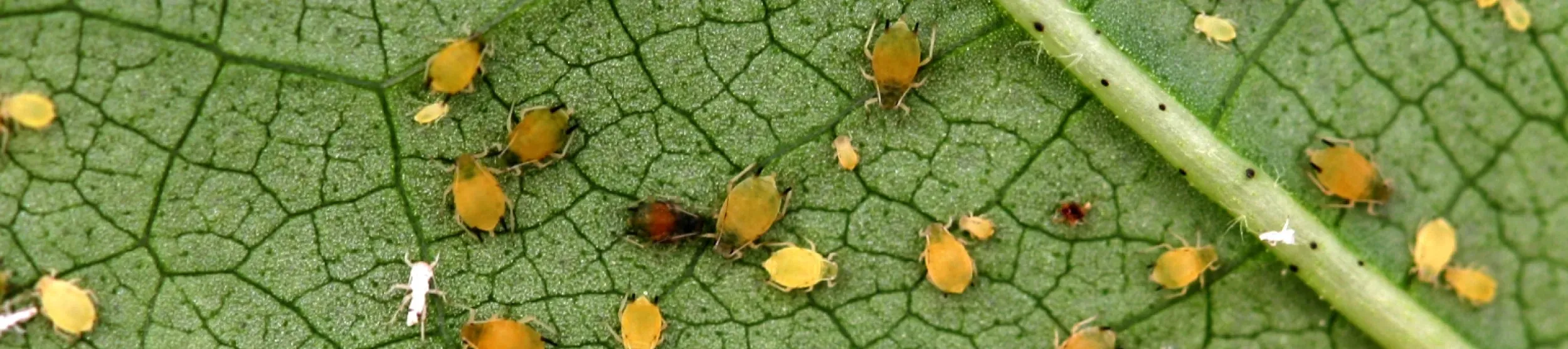
The problem: pests and pathogens are moving faster than our decisions
Agriculture has always been a race against biology, but the pace has changed. Invasive insects establish in new regions, plant pathogens expand their host range, and resistance to chemical controls spreads under selection pressure. At the same time, supply chains and climate variability create more frequent “surprise” introductions: a pest arrives on plant material, a pathogen hitchhikes in soil, or a disease erupts after unusual weather.
What hasn’t changed is the operational constraint in the field: growers and crop advisors must act quickly, often with partial information. When an infestation is early, symptoms may be subtle or easily confused with nutrient stress, herbicide injury, or abiotic damage. When it’s advanced, the cost of action rises sharply and options narrow. In both cases, time-to-answer is the deciding factor.
This is where genomics has quietly shifted from a research capability to an operational tool. DNA-based identification can turn an uncertain visual diagnosis into a specific, actionable target, enabling more precise interventions and better integrated pest management (IPM) decisions.
Visual ID and delayed lab results create avoidable losses
Many pests and plant diseases still rely on classical identification workflows: scouting, trap counts, microscopy, culturing, or shipping samples to a centralized lab. Those approaches remain valuable, but they introduce delay and ambiguity at the exact moment when precision matters.
Two issues recur across cropping systems. First, closely related organisms can look alike while requiring very different responses. Cryptic insect species, early larval stages, and pathogen complexes can defeat even experienced eyes. Second, the most damaging stage is often the least visible: an insect egg mass, a low-titer pathogen infection, or contaminated planting material that looks healthy.
Those gaps are amplified when decisions cascade across multiple stakeholders. A grower may need to justify a treatment, a processor may need to verify incoming lots, and a regulatory or biosecurity team may need confirmatory identification before taking action. Genomic tools don’t replace expertise, but they reduce the time between “something is wrong” and “we know what it is.”
What DNA-based pest and pathogen diagnostics change in practice
Modern molecular diagnostics typically use targeted amplification (such as qPCR) or sequencing-based identification to detect organism-specific DNA signatures. The practical benefit is not just sensitivity; it’s specificity. A well-designed assay can distinguish between species that share a host, separate pathogenic from non-pathogenic relatives, and detect an organism before symptoms or population growth make the problem obvious.
In day-to-day operations, rapid DNA diagnostics support three high-value decisions. They help determine whether an observed issue is biotic or abiotic, they help target control tactics to the right organism, and they help verify whether containment or sanitation measures worked. For IPM programs, that means fewer “insurance” sprays and more confidence in threshold-based interventions.
This is especially relevant as resistance management becomes harder. If a grower is forced to treat broadly because the pest ID is uncertain, selection pressure rises across non-target populations. By contrast, identifying the pest or pathogen quickly enables narrower, better-timed actions, which supports both efficacy and sustainability.
Where it matters most: early detection, mixed infections, and invasive threats
The highest return on rapid diagnostics tends to appear in scenarios where delays compound.
First, early detection. A low-density pest population or a small infection focus is often controllable with targeted measures, but only if the diagnosis is confident. Second, mixed infections and co-occurrence. Plants can host multiple pathogens, and insect damage can predispose tissue to secondary infections; treating the wrong primary driver wastes time and can worsen outcomes. Third, invasive species and regulated pests. Here, the value is not only protecting yield but also protecting market access and reducing the scope of quarantines.
These are the contexts where field-ready genomic testing is moving from “nice to have” to “expected,” especially as extension and advisory networks push for faster confirmation and more defensible recommendations.
How Evolvenomix makes genomics usable outside a specialized lab
Evolve Genomix was built around a simple premise: molecular science is only as useful as its turnaround time and usability in real conditions. As an NSF SBIR Phase I award winner, the company has been recognized for rapid pathogen detection tools designed to deliver answers in under an hour with greater than 99% accuracy, aligning the diagnostic timeline with operational decision-making.
For pest and plant disease management, Evolve Genomix connects identification to action through solutions that fit different points in the workflow. Evolve Pest Dx is designed as a portable DNA-based field test to support rapid confirmation when time and location matter, while Evolve Pest-Seq provides sequencing-based identification when deeper resolution is needed, such as distinguishing closely related pests or validating a suspected invasive. For plant health teams tracking outbreaks, Evolve Phyto supports plant pathogen identification and monitoring, helping clarify whether symptoms reflect a specific pathogen, a complex, or a shift in pathogen presence across a region or season.
When organizations need assays tailored to their crops, geographies, or risk profiles, Custom Tests enable targeted qPCR and NGS assay development that can be aligned to internal SOPs and sampling plans. And when the question expands from “what is it?” to “how is it evolving?”, Evolve M-Genome provides microbial genome sequencing solutions that can help characterize strains, support traceability, and inform long-term management strategies.
To make these tools operationally meaningful, test design and sampling strategy matter as much as instrumentation. The goal is not simply to generate a positive or negative result, but to produce a result that can be trusted under field constraints, interpreted by decision makers, and used to guide a next step.
A practical DNA-based IPM workflow typically benefits from three capabilities.
-
Rapid tests that confirm suspected targets while scouting or near the point of sampling, reducing delays and unnecessary treatments.
-
Sequencing-backed identification that provides higher-resolution confirmation when morphology is ambiguous or regulatory scrutiny is high.
-
Custom assay development that ensures diagnostics match the pests, pathogens, and matrices that matter in a specific production system.
What’s next: diagnostics as infrastructure for sustainable control
The near-term future of pest and plant disease management will be shaped less by any single chemistry or biological product and more by information quality. As farms and processors adopt more data-driven operations, diagnostics will increasingly function like infrastructure: a routine input that enables precision, documentation, and continuous improvement.
The most promising path forward is collaboration across the chain. Growers, crop consultants, extension scientists, processors, and public agencies each see different parts of the system; genomics can provide a shared language for what is present, what is changing, and what actions are justified. When rapid diagnostics are paired with good sampling, transparent interpretation, and feedback into IPM planning, the outcome is not just faster answers, but fewer wasted inputs, better resistance stewardship, and more resilient production.
Evolve Genomix’s role in that future is straightforward: keep DNA testing fast, practical, and affordable, so that genomic certainty is available at the moment decisions are made, not after the window to act has already closed.